Hands-on chart
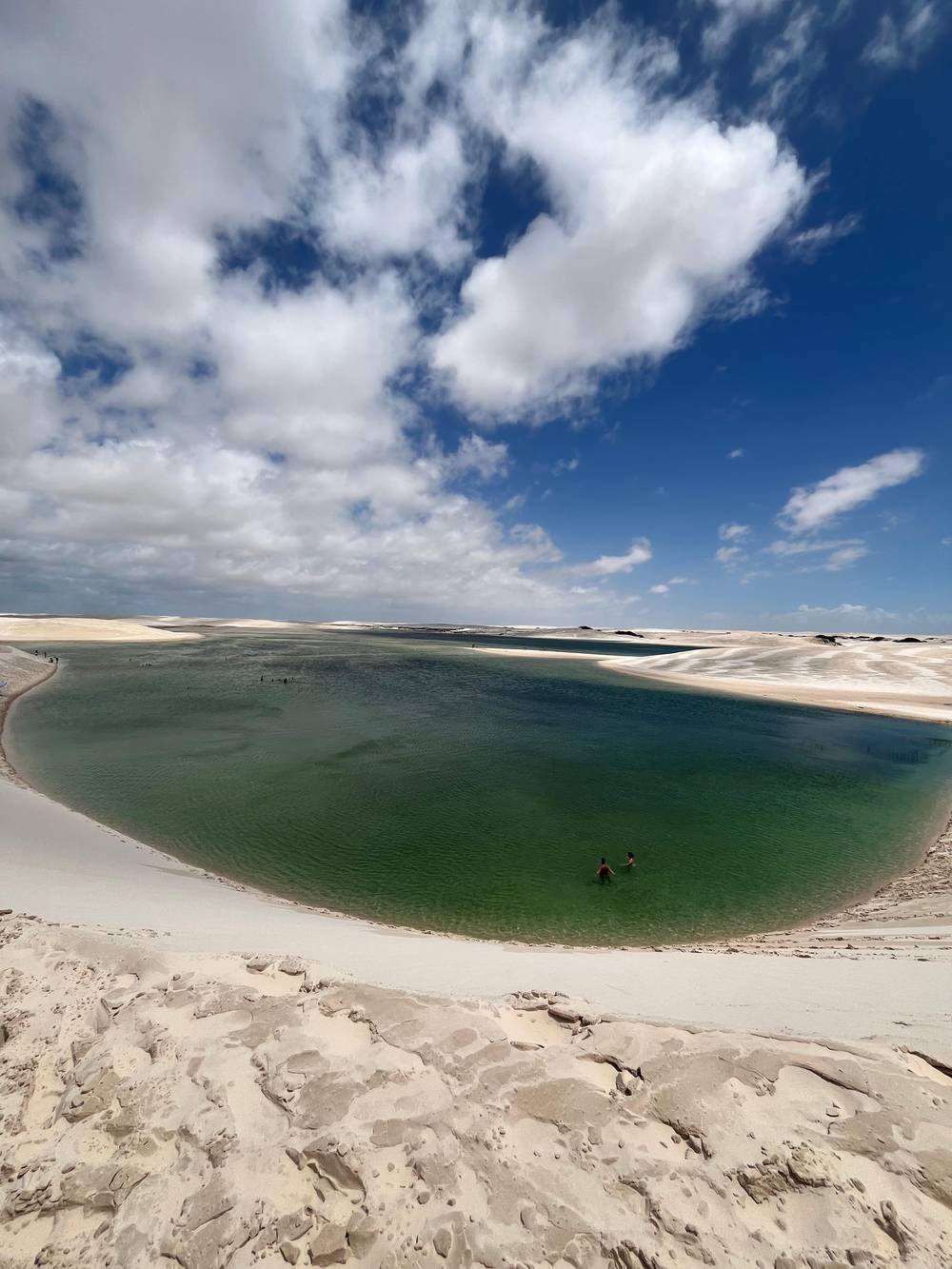
The Lencois Maranhenses lagoons at sunset, from Lagoa Bonita
The quick version
Watch the sunset from the dunes at Lagoa Bonita, reached by a 4x4 ride and a wooden staircase; the full-day combo tour sold here ends there, and the sunset time for each month is in the tool above.
Before you go
Sunset over the dunes
Lagoa Bonita through the year
Choose a month to see sunset, daylight and what the lagoons are doing.
Sunset
Jan
- Sunset close to 18:08
- The lagoons this month: Rains begin12
The rains return; the state counts January to July as the wet months.13
Feb
- Sunset close to 18:12
- The lagoons this month: Filling12
Showers and cloud are likely, but the sky can light up at dusk.13
Mar
- Sunset close to 18:05
- The lagoons this month: Filling12
Lagoons are still filling; trips run in the afternoon, when the sun is lower.5
Apr
- Sunset close to 17:53
- The lagoons this month: Filling12
Still the wet season: look for sunsets between the showers.13
May
- Sunset close to 17:47
- The lagoons this month: Full, settling12
Full lagoons and settled weather from this month.12
Jun
- Sunset close to 17:50
- The lagoons this month: Full12
Full lagoons, and fewer people on the crest than in July.12
Jul
- Sunset close to 17:56
- The lagoons this month: Full, busiest12
Aug
- Sunset close to 17:57
- The lagoons this month: Shrinking12
The rains have gone and the water slowly drops.14
Sep
- Sunset close to 17:49
- The lagoons this month: Shrinking12
Lagoons shrink, and the dry sand starts to glow at sunset.14,3
Oct
- Sunset close to 17:42
- The lagoons this month: Low12
Dry-season sand often turns golden and pink at dusk.3
Nov
- Sunset close to 17:43
- The lagoons this month: Low12
Low water; after dark the park is one of Brazil's best for stargazing.4
Dec
- Sunset close to 17:55
- The lagoons this month: Mostly dry12
Most lagoons are dry; the dunes and the sky remain.14
Sunset is worked out for the 15th of each month on Brazil time. Notes come from the Maranhao state tourism office, ICMBio and NASA, not from a weather station: none reports from the park.
Every classic lagoon day ends on a dune top facing west. Here is how to see the Lencois Maranhenses lagoons at sunset well, and what the dunes offer at dawn and after dark.
Editorial team, lencoismaranhensestour.quest · Updated November 11, 2026 · ~8 min read
Why every lagoon day ends on a dune top
Sunset is not an extra on a Lencois Maranhenses day; it is the way the day is built. The state tourism office says lagoon trips mostly head out in the afternoon, once the sun has dropped a little, and that the Lagoa Azul outing closes with everyone up on the dunes for sunset.5,6 The midday glare on white sand is fierce, so the best hours belong to the late afternoon.
Seeing the Lencois Maranhenses lagoons at sunset is also a matter of geometry. The dunes are white quartz, the lagoons are shallow and clear, and as the sun drops the sand turns from blinding white to cream, gold and pink while the water goes from turquoise to deep blue. NASA's explanation of the colours, light reflected off the sand through shallow water, is easy to watch changing in real time.7
The tour sold on this site is designed around that moment. It spends the first part of the day around Lagoa Azul and the later part around Lagoa Bonita, breaks for a meal at a local restaurant in between, and saves the sunset at Lagoa Bonita for last. Your guide times the climb so that the group is on the crest well before the sun goes down.
Sunset and night trips
Ways to end the day in the dunes
| Trip | Length | Price | What you get |
|---|---|---|---|
| Combo day, both circuits | Full day | from $90 | Sunset at Lagoa Bonita |
| Sunset at Lagoa Bonita | 4 hrs | from $51 | Afternoon and sunset only |
| Lagoa Bonita half day | 5 hrs | from $51 | Ferry, off-road ride, sunset |
| Day trip to Atins | 7 hrs | from $90 | Sunset in the dunes |
| Stargazing by boat | 3 hrs | from $53 | Binoculars on the river |
From-prices and lengths from the GetYourGuide listings; prices may change.
The climb at Lagoa Bonita
Lagoa Bonita owes its sunsets to its height. Few spots in the park stand higher, according to the park plan, and the panorama from the top shows just how far the dunes run.1 ICMBio describes the approach: a 4x4 ride over sand roads, then a wooden staircase leading up into the dunes.2 From the top, white sand and lagoons stretch ahead and green cerrado covers the land behind you.10
The staircase is the steep part; after it, you walk on soft sand along the ridges to the lagoons and the viewpoints. Getting there takes longer than the run to Lagoa Azul, on the state's account, with off-road tracks most of the way.8 Take your time on the climb, carry water, and keep something warm in your bag for the wind on the crest once the sun is low. Shoes come off for the sand, so carry them.
Once up, spread out. The group tends to bunch on the first high crest, but the dunes run in long ridges, and a short walk along one often gives you a lagoon in the foreground and the sun dropping behind the next line of sand. Check with your guide when the group will start down, and be back at the meeting point when they say: in the dunes, the light fades faster than you expect.
The last hours
An afternoon at Lagoa Bonita
After lunch
Back in the truck
A restaurant stop comes before the second circuit.
Mid-afternoon
Off-road to Lagoa Bonita
It lies farther out than Lagoa Azul.8
Late afternoon
Up the staircase
A wooden staircase leads into the dunes.2
Golden hour
Swim and walk the ridges
The view spans the whole dune field.1
Sunset
On the crest
The day ends with sunset at Lagoa Bonita.
Dusk
Back to town
Accredited drivers take you back in the dark.9
Sunset times through the year
Barreirinhas sits just south of the Equator, so the sun rises and sets at much the same time all year, and the length of daylight barely changes between the months. That steadiness makes planning easy: the sunset comes at much the same hour whatever month you travel, and your tour will be timed to reach the top of the dunes in good time before it. Expect the sky to darken quickly once the sun has gone, as it does everywhere in the tropics.
What changes through the year is not the clock but the scene. From May, the park plan describes full lagoons and settled weather, the best combination for a sunset with water in it.12 The state's wet season runs from January to July, months when cloud can hide the sun but also set the whole sky alight.13 After that the water drains away little by little, and by December, NASA notes, most lagoons have gone.14 In the dry months the lagoons shrink, and the state tourism office notes that the sand often takes on golden and pink tones as it reflects the sunset.3
If the sunset is your priority, think about crowds as well as weather. July is the busiest month in the park, and the Lagoa Azul and Lagoa Bonita area draws more visitors and vehicles than anywhere else in it.12,15 In those weeks the main crest gets busy, so a guide who walks you a few minutes further along the ridge is worth more than a perfect forecast. Weekdays outside the July holidays are calmer still.
Which end of the day?
Choose your light
Match the time of day to what you want.
If I want the famous view at sunset
Lagoa Bonita
It rises above most of the dune field.1
If I want sunset plus both lagoon circuits
The combo day
It ends with sunset at Lagoa Bonita.
If I only have an afternoon
A sunset half day
A Lagoa Bonita trip runs 5 hours.
If I want to see the stars
A night on the river
A 3-hour stargazing boat trip.
If I want the whole bedsheet from above
A scenic flight
About 30 minutes, booked in advance.11
Where to stand and how to photograph it
Face the light, then turn around. The classic shot looks west over a lagoon with the sun low in the sky, but the gentlest colours often appear behind you, where the low sun lights up the dune ridges and their long shadows. Shoot the ripples on the windward slopes, the reflections in still water and the silhouettes of people on the crests, and leave the phone in your pocket for the last minutes.
Sand is the enemy of cameras. Keep lenses capped and phones in a zip bag between shots, change lenses only out of the wind, and wipe your hands before handling gear after a swim. A small cloth and a blower brush in your bag will save a lot of grief. If a pre-sunset swim is on your list, keep a dry bag for everything that cannot get wet, and set it down on a towel rather than on the sand.
Drones need special care. The management plan allows them in the park only within the national aviation agency's rules and with the park's own authorisation.19 For a view from above, the management plan allows scenic flights over the park outside its most sensitive areas, and the state tourism office puts a flight at around 30 minutes, to be arranged ahead with local agencies.20,11 Booked for late afternoon, a flight shows the whole bedsheet lit from the side.
Sunset trips
Price an evening in the dunes
Set the trip and the size of your party.
Compare 4 choices
Price an evening in the dunes
Set the trip and the size of your party.
- Combo day with sunsetFull day · for each guest from $90
≈
View - Lagoa Bonita sunset4 hrs · for each guest from $51
≈
View - Lagoa Bonita half day5 hrs · for each guest from $51
≈
View - Bonita high dunes, sunset5 hrs · for each guest from $55
≈
View
From-prices on GetYourGuide, shown at the ECB reference rate. Your exact price is confirmed during booking.
The drive back in the dark
After the sun goes down, the light fades fast. You walk back over the dunes and down to the vehicles in twilight, then ride back toward Barreirinhas in the dark. The tracks are sandy, bumpy and unlit, and only accredited vehicles and drivers are allowed to carry visitors in the park.9 Sit back, hold on, and let the driver do the work; the stars often come out before you reach the road.
Prepare for that last hour before you leave in the morning. A headlamp or phone torch helps on the walk back, a light long-sleeved layer keeps off the evening breeze and the insects, and ICMBio's advice to carry insect repellent matters most at dusk.16 Keep your water bottle handy too: you will have spent the hottest hours of the day on the sand, and dehydration catches up with people at the end of the day.
Pickup at your lodging is part of the combo day; confirm at booking where the vehicle drops you after dark. If you are on a half-day sunset trip instead, check where it ends before booking, and whether it collects you from your lodging. The half-day Lagoa Bonita trip, for example, runs 5 hours, including a ferry across the Preguicas river and an off-road vehicle over sandy tracks.
Video
The desert lagoons that disappear every year
TunaBaby on YouTube · Your tap on play is what loads the video.
At the end, the visitors gather on top of the dunes to take in the dazzling sunset.
Sunrise and dawn walks
There is no classic sunrise circuit like the sunset one, but dawn is when the walkers move. The state tourism office notes that crossings on foot start before dawn to avoid the hottest sun, which begins around 10h.21 Expeditions to the oasis of Queimada dos Britos also set off before dawn for the same reason.22 If you stay in Atins or Santo Amaro, the edge of the dunes is close enough for a short sunrise walk with a guide.
A sunrise tour in Lencois Maranhenses is therefore something to arrange privately rather than book off the shelf. Ask an operator in your base town for an early private departure, and agree the route and the return time in advance. The light at dawn is softer and cooler than at sunset, the sand is firmer after the night, and you will usually meet nobody else on the crests. Bring a snack: breakfast will be waiting when you get back.
Whatever you do, keep out of the midday sun. ICMBio's advice is to stay off the sand from 11 to 15 hours.23 A good day in the dunes uses both ends: a dawn walk, a long shaded break at noon, and the lagoons again in the late afternoon. The state's advice on sunscreen, swimwear, light clothes and constant drinking applies to both.5 Plan your meals and your rest around the light, not the clock.
Stargazing and the night on the dunes
When the last light goes, the sky takes over. ICMBio's public use plan notes that the park offers one of the best opportunities for night-sky observation in Brazil, and lists stargazing among the activities on offer.4,24 With little artificial light across the dune field, the Milky Way can be bright on moonless nights. Give your eyes time to adjust away from torches and screens.
A Lencois Maranhenses night tour usually means one of two things. One is a night in the oasis villages on the crossing, where the dark is complete.25 The other is a short evening trip from Barreirinhas: one listing runs a 3-hour stargazing tour by speedboat on the Preguicas river, with binoculars and astronomical instruments, from $53. Ask if that figure is per head or for your whole party before you book.
Plan the night around the moon. A full moon lights up the white sand almost like day, which is magical for a walk but washes out the stars. A new moon gives the darkest sky. Remember that the park bans fires everywhere, so there are no bonfires on the dunes, and walking out alone at night is a bad idea in a place where it is easy to get lost.17,18 Stargaze with a guide, or from the edge of town.
FAQ
Fast answers to common questions.
Where should I watch the sunset?
Its dunes rise above most of the field, giving a wide view.1
Does the tour on this site include the sunset?
The full combo day finishes on the Lagoa Bonita dunes as the sun goes down.
How do you get up the dune at Lagoa Bonita?
A 4x4 ride on sand roads leads to the staircase.2
Can I fly a drone at sunset?
Drones need to follow the aviation rules and have the park's authorisation.19
Is there a sunrise tour?
Treks start before dawn to avoid the sun from around 10h.21
Can I go stargazing?
The park plan rates the night sky among Brazil's best; a 3-hour boat tour runs from Barreirinhas.4
Are campfires allowed on the dunes?
Lighting fires is forbidden anywhere in the park.17
Sources
- ICMBio (Instituto Chico Mendes de Conservacao da Biodiversidade) - Public Use Plan (PDF, via the MMA national register) · Plano de Uso Publico do Parque Nacional dos Lencois Maranhenses (2022) ↩
- ICMBio, Instituto Chico Mendes de Conservacao da Biodiversidade, the federal park authority (gov.br/icmbio) · Municipio Barreirinhas (Polo Lagoas and Polo Atins) ↩
- Secretaria de Estado do Turismo do Maranhao (SETUR-MA) · Voo Motor ↩
- ICMBio (Instituto Chico Mendes de Conservacao da Biodiversidade) - Public Use Plan (PDF, via the MMA national register) · Plano de Uso Publico do Parque Nacional dos Lencois Maranhenses (2022) ↩
- Secretaria de Estado do Turismo do Maranhao (SETUR-MA) · Parques Nacionais - Patrimonio Natural ↩
- Secretaria de Estado do Turismo do Maranhao (SETUR-MA) · Parques Nacionais - Patrimonio Natural ↩
- NASA Earth Observatory · The Paradox of Lencois Maranhenses National Park ↩
- Secretaria de Estado do Turismo do Maranhao (SETUR-MA) · Parques Nacionais - Patrimonio Natural ↩
- ICMBio, Instituto Chico Mendes de Conservacao da Biodiversidade, the federal park authority (gov.br/icmbio) · Municipio Barreirinhas (Polo Lagoas and Polo Atins) ↩
- ICMBio, Instituto Chico Mendes de Conservacao da Biodiversidade, the federal park authority (gov.br/icmbio) · Municipio Barreirinhas (Polo Lagoas and Polo Atins) ↩
- Secretaria de Estado do Turismo do Maranhao (SETUR-MA) · Voo Motor ↩
- ICMBio (Instituto Chico Mendes de Conservacao da Biodiversidade) - Public Use Plan (PDF, via the MMA national register) · Plano de Uso Publico do Parque Nacional dos Lencois Maranhenses (2022) ↩
- Secretaria de Estado do Turismo do Maranhao (SETUR-MA) · Parques Nacionais - Patrimonio Natural ↩
- NASA Earth Observatory · The Paradox of Lencois Maranhenses National Park ↩
- ICMBio (Instituto Chico Mendes de Conservacao da Biodiversidade) - Public Use Plan (PDF, via the MMA national register) · Plano de Uso Publico do Parque Nacional dos Lencois Maranhenses (2022) ↩
- ICMBio, Instituto Chico Mendes de Conservacao da Biodiversidade, the federal park authority (gov.br/icmbio) · Orientacoes ao Visitante (visitor guidance and rules) ↩
- ICMBio (Instituto Chico Mendes de Conservacao da Biodiversidade) · Trekking - Travessia dos Lencois ↩
- ICMBio, Instituto Chico Mendes de Conservacao da Biodiversidade, the federal park authority (gov.br/icmbio) · Polo Oasis ↩
- ICMBio (Instituto Chico Mendes de Conservacao da Biodiversidade) - Management Plan (PDF, via the MMA national register) · Plano de Manejo, Encarte 6 - Planejamento do Parque Nacional dos Lencois Maranhenses (revised 2022) ↩
- ICMBio (Instituto Chico Mendes de Conservacao da Biodiversidade) - Management Plan (PDF, via the MMA national register) · Plano de Manejo, Encarte 6 - Planejamento do Parque Nacional dos Lencois Maranhenses (revised 2022) ↩
- Secretaria de Estado do Turismo do Maranhao (SETUR-MA) · Trekking e Expedicao Fotografica ↩
- Secretaria de Estado do Turismo do Maranhao (SETUR-MA) · Experiencia de Base Comunitaria ↩
- ICMBio, Instituto Chico Mendes de Conservacao da Biodiversidade, the federal park authority (gov.br/icmbio) · Trekking - Travessia dos Lencois ↩
- ICMBio (Instituto Chico Mendes de Conservacao da Biodiversidade) - Public Use Plan (PDF, via the MMA national register) · Plano de Uso Publico do Parque Nacional dos Lencois Maranhenses (2022) ↩
- ICMBio (Instituto Chico Mendes de Conservacao da Biodiversidade) - Public Use Plan (PDF, via the MMA national register) · Plano de Uso Publico do Parque Nacional dos Lencois Maranhenses (2022) ↩
Up next